


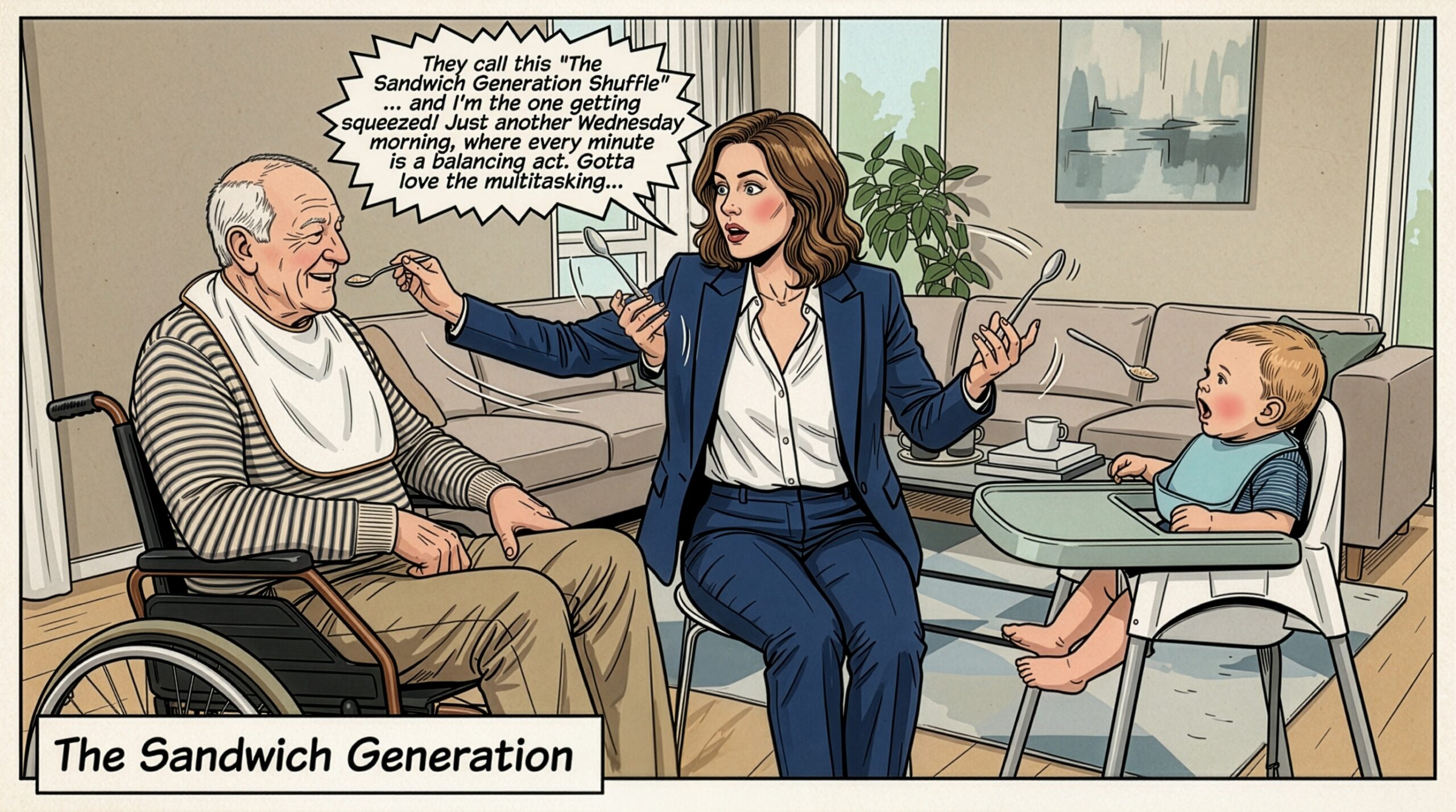
You are simultaneously texting your teenager about dinner and researching memory care facilities for your mom. Welcome to the sandwich generation — the layer in the middle holding everything together while quietly running out of room.
This article is for the women doing both, and doing it hard. Here are practical moves that actually help — not platitudes, not guilt, just strategy.
Sandwich generation caregivers are adults providing active support to both younger children and older parents at the same time. Studies show women in this position are at higher risk for chronic stress and identity erosion, but practical boundary-setting and delegation tools can shift that trajectory.
What's Actually Happening
The term sandwich generation describes adults — disproportionately women — who are simultaneously raising children and providing care or support to aging parents. Caregiving research consistently describes this dual role as a source of elevated psychological distress and strain, disproportionately affecting women. It is not a soft inconvenience. It is a structural load with physiological consequences.
What makes this generation particularly exposed is timing. Women in their 40s and 50s are already navigating perimenopause and its hormonal shifts, often at peak career intensity, while simultaneously absorbing caregiving demands from both ends of the family. The research confirms what many women feel but rarely name: the middle layer carries the most weight and receives the least institutional support.
Losing yourself slowly inside your roles is not noble. It is a signal. And it is reversible.
Why This Matters for You
Identity is not a luxury conversation for this season — it is a survival one. When caregiving expands to fill every available hour, women consistently report losing their sense of who they are outside of their roles. That loss is not abstract. It correlates with increased anxiety, decreased relationship satisfaction, and reduced motivation to maintain their own health.
The good news is that the same research points to modifiable factors. Social support, role clarity, and deliberate time boundaries are among the variables most consistently associated with better outcomes for sandwich generation women.
What You Can Actually Do
- Name your roles out loud — Write down every caregiving role you currently hold and estimate the weekly hours each requires. Seeing the full picture in one place is the first step toward making intentional choices about where to reduce, delegate, or ask for help.
- Create a family care meeting cadence — A short, recurring check-in with siblings, a partner, or other family members distributes cognitive load and reduces the invisible mental labor of being the sole keeper of everyone's information.
- Protect one non-negotiable hour daily — Not for productivity, not for caregiving. One hour that belongs to you, whether that is a walk, a call with a friend, or reading. Research on caregiver burnout consistently identifies personal time as a protective factor, not a reward.
- Use a shared digital coordination tool — Apps like Lotsa Helping Hands or a shared calendar reduce the friction of coordinating care logistics and make it easier to accept help without managing every incoming offer yourself.
- Talk to your doctor about your own health markers — Sandwich generation women are statistically more likely to delay their own medical care. If it has been over a year since you had a full checkup, that is worth prioritizing, especially given the hormonal changes happening in parallel during this decade.
Q&A with the Coach
Is it normal to feel resentful even when I love the people I am caring for?
Completely normal, and well-documented in caregiver research. Resentment is often a sign that the load is unequally distributed, not that you are a bad daughter or mother.
How do I get siblings to share the load when they just do not step up?
Start with specifics rather than general requests — a specific task, a specific time window, a specific outcome. Vague requests to help more rarely change behavior; concrete asks sometimes do.
I feel guilty whenever I do something for myself. How do I work through that?
Guilt in caregivers often functions as a monitoring system that got miscalibrated — it fires when you rest, not just when you actually fail someone. Noticing the difference between those two things is a useful starting point, and a therapist familiar with caregiver dynamics can help with the rest.
At what point does caregiving stress become something I should talk to a doctor about?
If you are experiencing persistent sleep disruption, low mood that does not lift, or you have been skipping your own medical appointments for more than a year, those are worth raising with your doctor directly. This is not a threshold for crisis — it is just information worth sharing.
Is there a way to plan ahead so I am not always in reactive mode?
A family meeting cadence, even a short monthly one, combined with a written overview of both your parents' care needs and your household logistics, shifts you from reactive to proactive in a way that is surprisingly sustainable.
Being sandwiched between generations is one of the most demanding things a woman can navigate — structurally, emotionally, and physically at once. The research confirms what you already feel. That matters.
You do not have to dissolve into this season. The moves are small, the shifts are real, and the version of yourself on the other side of this is worth protecting right now.
What do you think?
If this resonated, our newsletter goes deeper on purpose, identity, and the practical side of midlife. Join the women already reading it.
Source: pmc.ncbi.nlm.nih.gov
Source: Examining Mental and Physical Health Status Among Sandwich Generation Caregivers
Created with AI assistance