


If you have ever wondered whether timing matters with hormone therapy, a large new study suggests the answer is yes — and your 40s may be the most meaningful years in that equation. The science is promising, the caveats are real, and you deserve both.
Estradiol decline during perimenopause and menopause is associated with measurable increases in biological aging, according to a 2026 study of over 54,000 participants. The effect sizes are modest but meaningful, and the research points toward an optimal window for HRT initiation in the early-to-mid menopause transition.
What's Actually Happening
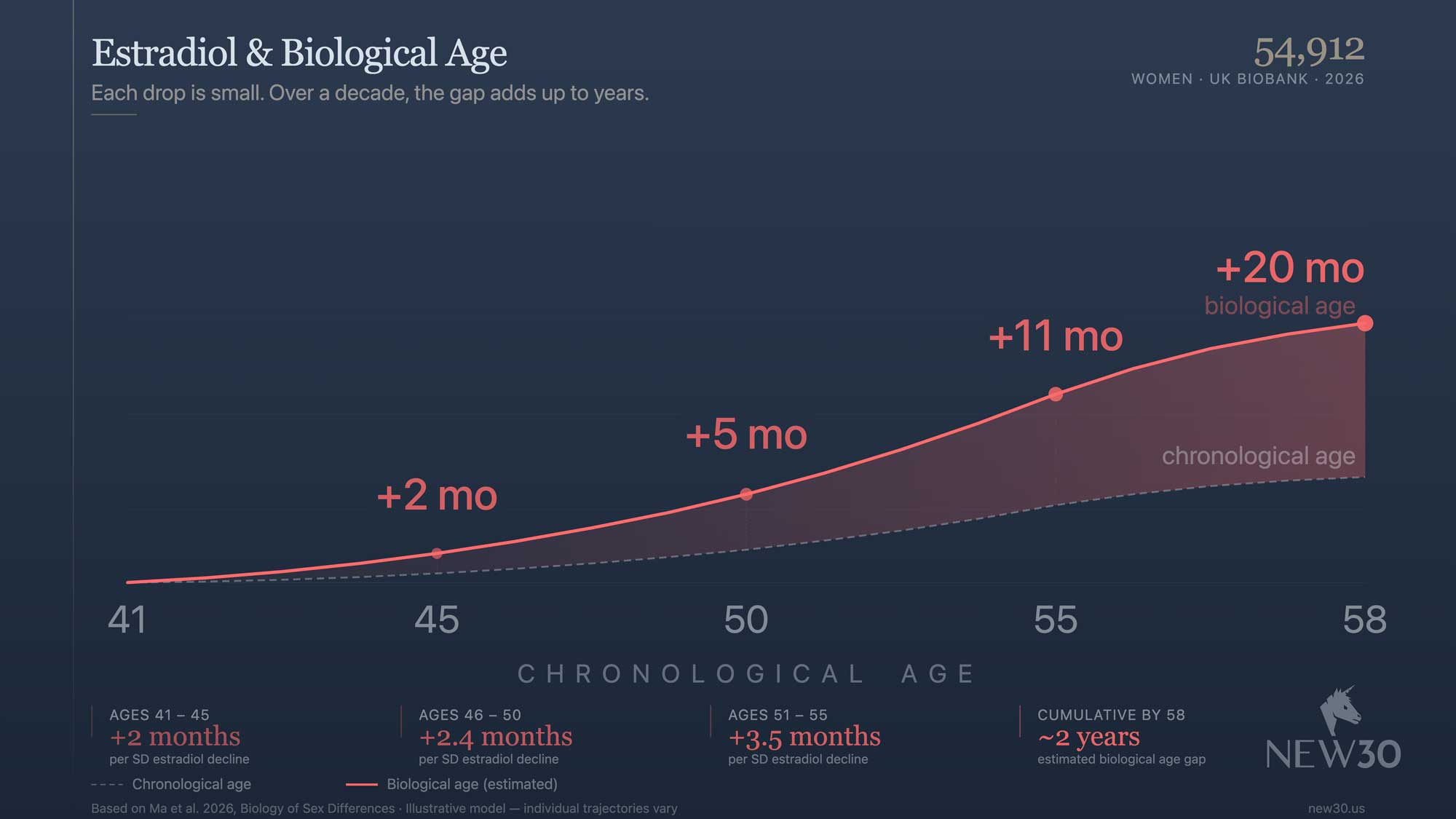
A 2026 study published in Biology of Sex Differences analyzed data from 54,912 UK Biobank participants and found that declining estradiol in women is associated with biological age acceleration of roughly 0.18 to 0.29 years. That may sound small in absolute terms, but compounded over the perimenopause transition it adds up — and the association was most pronounced between ages 41 and 55. The researchers describe this period as an optimal HRT initiation window for slowing biological aging in females.
This finding does not stand alone. A 2016 study published in PNAS using epigenetic clock data found that menopause accelerates biological aging, and a 2020 study in PubMed / Aging found that estradiol supplementation can blunt that acceleration as measured by the glycan age index. Taken together, the picture is coherent — but it is still built on observational evidence, meaning the studies show association, not confirmed causation.
The research does not say everyone needs HRT. It says timing may matter more than we thought — and your 40s are where the signal is loudest.
Why This Matters for You
If you are in your early-to-mid 40s or navigating perimenopause, this research positions that timing as potentially more significant than previously understood. Biological aging tools like epigenetic clocks are still maturing as clinical measures, so the numbers are directional rather than definitive — but the consistency across multiple large datasets is worth paying attention to.
The caveats matter just as much as the headline. HRT initiated well after menopause carries increased risks of stroke, blood clots, and in some analyses, dementia. Individual health history changes the calculus entirely. This is science that informs a conversation with your doctor — not a prescription.
What You Can Actually Do
- Talk to your doctor about timing — If you are in perimenopause or early menopause and HRT is on your radar, ask specifically about the timing window and what the current evidence suggests for your health profile.
- Track your biological age over time — Tools measuring phenotypic age or glycan age are not clinical gold standards yet, but they can give you a baseline and a way to observe change across interventions.
- Know your estradiol levels — Asking for hormone panel labs during your annual visit gives you actual data rather than symptom-only management, and puts the conversation with your provider on firmer ground.
Q&A with the Coach
Does this study mean I should start HRT immediately if I am in my 40s?
Not exactly — the study identifies an association between estradiol levels and biological aging, not a universal prescription. What it does mean is that your 40s are a genuinely meaningful time to have an informed, data-driven conversation with your doctor about your hormone levels and options.
What is biological age and how is it different from my actual age?
Biological age reflects how fast your cells and systems are aging relative to your chronological years — it can be measured using tools like epigenetic clocks or glycan age markers. These tools are still maturing clinically, but they consistently show that menopause-related estradiol decline speeds up biological aging in measurable ways.
The effect sizes sound small — 0.29 years. Should I even care?
In isolation, 0.29 years sounds minor, but biological aging acceleration compounds over time across multiple systems — cardiovascular, cognitive, metabolic. The researchers saw this signal most clearly in the 41–55 window, which is exactly when many women are navigating the early stages of the menopause transition.
What are the risks of starting HRT if I am in my mid-40s?
That depends heavily on your individual health history, which is why this conversation belongs with your doctor rather than in a general article. What the research does consistently show is that risks — including stroke and blood clots — tend to increase when HRT is initiated significantly later in the menopause transition, not in the earlier window.
Are there things I can do to support biological aging even if HRT is not right for me?
Yes — resistance training, sleep quality, and metabolic health all influence biological aging markers independent of hormone therapy. Estradiol is one significant input in a larger system, and the research on lifestyle interventions affecting epigenetic age is genuinely robust.
Across a 54,912-person dataset, a consistent picture emerges: estradiol protects against biological age acceleration, and that protection matters most in the years many women spend in the early stages of the menopause transition. The tools measuring biological age are still evolving, but the signal is real.
You do not need to have all the answers before the conversation starts. You just need to know the right questions — and now you have a few more of them.
What do you think?
If you want research like this in your inbox — translated, contextualized, and actually useful — our newsletter covers longevity, hormones, and the science that matters for women in their 40s and 50s. Sign up and stay in the conversation.
References: Biology of Sex Differences / Springer
Biology of Sex Differences (Springer Nature, 2026) — Divergent impacts of estradiol/testosterone reduction on biological aging: optimal HRT window in females recommended:
PNAS (2016) — Menopause accelerates biological aging:
PubMed / Aging (2020) — Effects of estradiol on biological age measured using the glycan age index
Created with AI assistance