



If you're in your mid-30s and something feels off — your sleep is disrupted, your anxiety has spiked, your mood swings don't match your life — you're probably not imagining it. Emerging research now confirms that perimenopausal symptoms can begin well before 40. Here's what the science actually shows, and why so many women this age are being missed by their doctors.
Perimenopause typically begins in the 40s, but a large 2025 study found that 55.4% of women aged 30 to 35 reported moderate to severe symptoms — most of them psychological rather than physical. If your mood, sleep, or cognitive clarity has shifted unexpectedly, hormonal changes are worth discussing with a healthcare provider.
What's Actually Happening
Perimenopause is the hormonal transition that precedes menopause, and it has long been associated with women in their late 40s. But a landmark 2025 peer-reviewed study published in npj Women's Health, conducted across more than 4,400 women via UVA Health and the Flo app, found that 55.4% of women aged 30 to 35 were already experiencing moderate to severe perimenopausal symptoms. That is not a small sample. That is a pattern.
What makes early-onset perimenopause particularly easy to miss is that the symptoms skew psychological rather than physical. Hot flashes — the classic marker — don't tend to peak until ages 51 to 55. What shows up earlier is anxiety, irritability, mood changes, sleep disturbances, and brain fog. These are symptoms that get attributed to stress, burnout, or a mental health diagnosis far more often than to hormones.
More than half of women aged 30 to 35 reported moderate to severe perimenopausal symptoms in a 2025 study — and most of those symptoms looked like anxiety, not hot flashes.
When Symptoms Actually Start: A Research-Backed Timeline
This is where the science gets clarifying. The symptoms associated with perimenopause don't arrive as a single wave — they emerge across a decade or more, and the earliest ones are almost never flagged as hormonal. Here's what the research shows, by symptom and reported onset age:
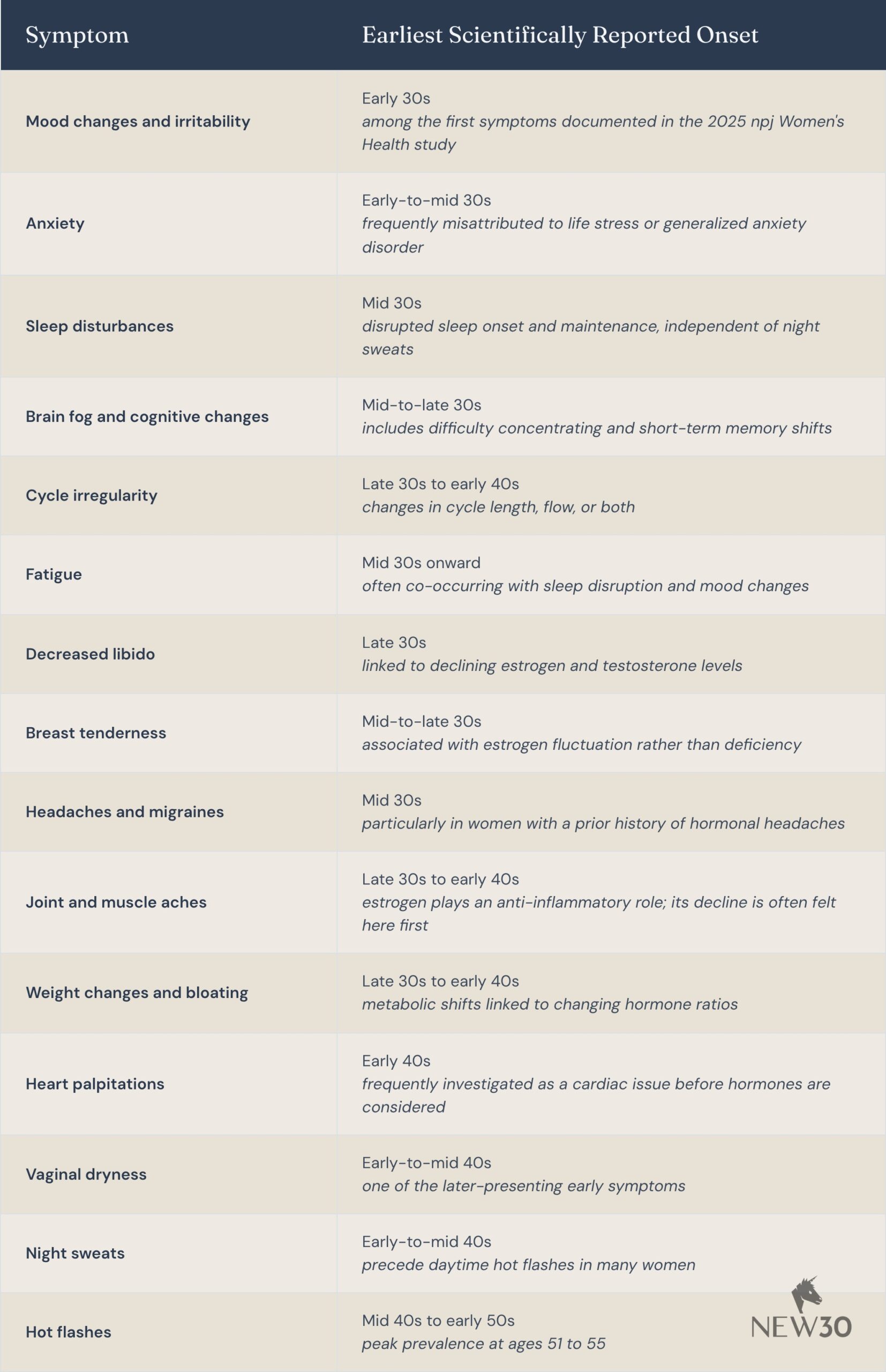
A few things worth noting: symptoms in the earlier rows are the ones most likely to be misread. They're common, they're diffuse, and they overlap with a dozen other explanations. That's precisely why tracking them together — rather than presenting each one in isolation to a doctor — tends to change the conversation.
Why This Matters for You
According to a 2025 national survey, nearly 40% of women seeking care for perimenopausal symptoms felt they had been misdiagnosed — often receiving treatment for anxiety or depression without anyone investigating the hormonal picture underneath. That gap in diagnosis means years of management that addresses the symptom but not the source.
As Contemporary OB/GYN notes, clinical consensus still places typical perimenopause onset in a woman's 40s, but emerging research firmly validates that earlier onset is real. Knowing this doesn't create a crisis — it creates a much better starting point for a conversation with your doctor.
What You Can Actually Do
- Track your symptoms with specificity — note mood shifts, sleep quality, cycle changes, and cognitive patterns over 60 to 90 days so you arrive at any medical appointment with data, not just a feeling.
- Ask about hormonal evaluation — if your symptoms align with what the research describes, ask your doctor about hormone panel testing and specifically mention early perimenopause as a possibility worth ruling in or out.
- Find a provider who knows this territory — not all clinicians are equally trained in perimenopausal care, particularly for women under 40, so seeking out a menopause specialist or ob-gyn with that focus can change the quality of the conversation significantly.
Q&A with the Coach
I'm 36 and my anxiety has spiked out of nowhere. Could this actually be hormonal?
It genuinely could be — a 2025 study found anxiety and mood changes are among the most common early perimenopausal symptoms in women your age, and they often show up before any cycle changes. It's worth tracking alongside your cycle and raising it explicitly with your doctor as a possible hormonal picture.
My doctor keeps telling me I'm too young for perimenopause. How do I push back?
You can reference the 2025 npj Women's Health study, which found that over 55% of women aged 30 to 35 reported moderate to severe perimenopausal symptoms — that's peer-reviewed data published in a credible journal. Asking for a hormonal evaluation to rule it in or out is a completely reasonable request.
What symptoms should I actually be tracking if I suspect early perimenopause?
Focus on mood shifts, sleep quality, cycle regularity, cognitive clarity, and energy levels — these are the early markers that research identifies in women under 40. A 60 to 90 day log gives your provider something concrete to work with rather than a general sense that something feels off.
Is early perimenopause the same as premature menopause?
They are different — premature menopause, also called premature ovarian insufficiency, means menstruation has stopped before age 40, while early perimenopause refers to the transitional hormonal fluctuations that can begin in the 30s while cycles are still present. If you are experiencing symptoms, a doctor can run blood work to help clarify which picture fits.
If I'm in early perimenopause, does that mean I'll hit menopause earlier too?
Not necessarily — experiencing perimenopausal symptoms early doesn't reliably predict when you'll reach menopause, as the transition timeline varies significantly from woman to woman. What it does suggest is that your hormones are already in flux, which is useful information for your long-term health planning.
Perimenopause starting at 35 is not a fringe theory — it is backed by peer-reviewed research and a growing body of clinical recognition. The symptoms are real, they skew psychological, and they are underdiagnosed at a significant rate.
You don't need to have all the answers before you ask the questions. Knowing that this is possible, knowing what it can look like, and knowing that you can request a proper evaluation — that's already a different starting point than most women your age get.
What do you think?
If you want research like this delivered straight to you — the studies, the context, and the things your doctor may not have mentioned yet — join the new30 newsletter.
Created with AI assistance
References: npj Women's Health (2025) — UVA Health / Flo Study:
Contemporary OB/GYN — Perimenopause symptoms common in women as young as 30:
Healthline Health News — Many Young Women Have Untreated Perimenopause: