


If your entire skincare strategy is built around collagen, you're solving for one piece of a much larger puzzle. Peer-reviewed research points to at least four deeper mechanisms driving how skin ages — and collagen is almost a downstream effect of them.
Here's what the science is actually tracking, explained without the jargon.
The four biomarkers researchers flag as most significant for skin aging after 40 are advanced glycation end-products, cellular senescence, mitochondrial dysfunction, and inflammaging. The 40–55 window is particularly relevant because declining hormones accelerate all of these pathways at the same time.
What's Actually Happening
For decades, skin aging research centred almost entirely on collagen — its production, its breakdown, how to stimulate more of it. But a growing body of peer-reviewed work tells a more complicated story. According to research published in Frontiers in Medicine, senescent fibroblasts — cells that have stopped dividing but haven't cleared from the skin — are now considered a primary driver of skin aging, not a side effect. These cells secrete a cocktail of pro-inflammatory molecules (called the senescence-associated secretory phenotype, or SASP) that actively degrade healthy surrounding tissue and compromise the skin barrier.
At the same time, advanced glycation end-products (AGEs) accumulate in the skin over time — a process accelerated by both age and blood sugar fluctuations. Research in PubMed has confirmed that AGEs can now be measured non-invasively via skin autofluorescence, meaning they are a trackable, not just theoretical, marker. Add to this the decline in NAD+ — a coenzyme essential for mitochondrial function — and the resulting energy deficit inside skin cells, and you have a picture of aging that goes several layers deeper than collagen.
The skin changes many women notice after 40 are not one thing going wrong. They are four biological processes converging at the same time — and hormonal decline is accelerating all of them.
Why This Matters for You
For women in the 40–55 window, these four pathways — AGEs, cellular senescence, mitochondrial dysfunction, and inflammaging — do not operate independently. Emerging research specifically on perimenopausal and postmenopausal women shows that hormonal decline accelerates all of them simultaneously, according to findings summarised in Frontiers in Medicine. This is not a reason to panic. It is a reason to update the framework you use to understand what is happening and why.
Most consumer products still market to the collagen narrative, which is not wrong — but it is incomplete. Knowing which deeper mechanisms exist helps you ask better questions, read labels more critically, and have more informed conversations with dermatologists.
What You Can Actually Do
- Ask about AGEs — If you see a dermatologist or functional medicine practitioner, ask whether skin autofluorescence testing is available; it offers a non-invasive window into AGE accumulation that a visual exam alone cannot provide.
- Prioritise mitochondrial support — NAD+ precursors like NMN and NR are in early clinical stages for skin-specific outcomes, but the mitochondrial pathway is well-established; talk to your doctor about whether these are appropriate for you before adding them.
- Take inflammation seriously at the skin level — Chronic low-grade inflammation (inflammaging) is driven in part by senescent cells; lifestyle factors including sleep quality, dietary patterns, and exercise have documented effects on inflammatory load, and that extends to skin tissue.
Intrinsic vs. Extrinsic Skin Ageing Factors
When it comes to how your skin changes, there are really two forces at work. Intrinsic ageing is the stuff you can't negotiate with — time, genetics, hormonal shifts, immune function, and the natural activity of free radicals in your cells. Then there's extrinsic ageing: UV exposure, pollution, smoking, dehydration, poor sleep, stress, diet, and the skincare routine that may not be doing what you think it's doing. The first category is biology. The second is largely within your control — and that's where it gets interesting.
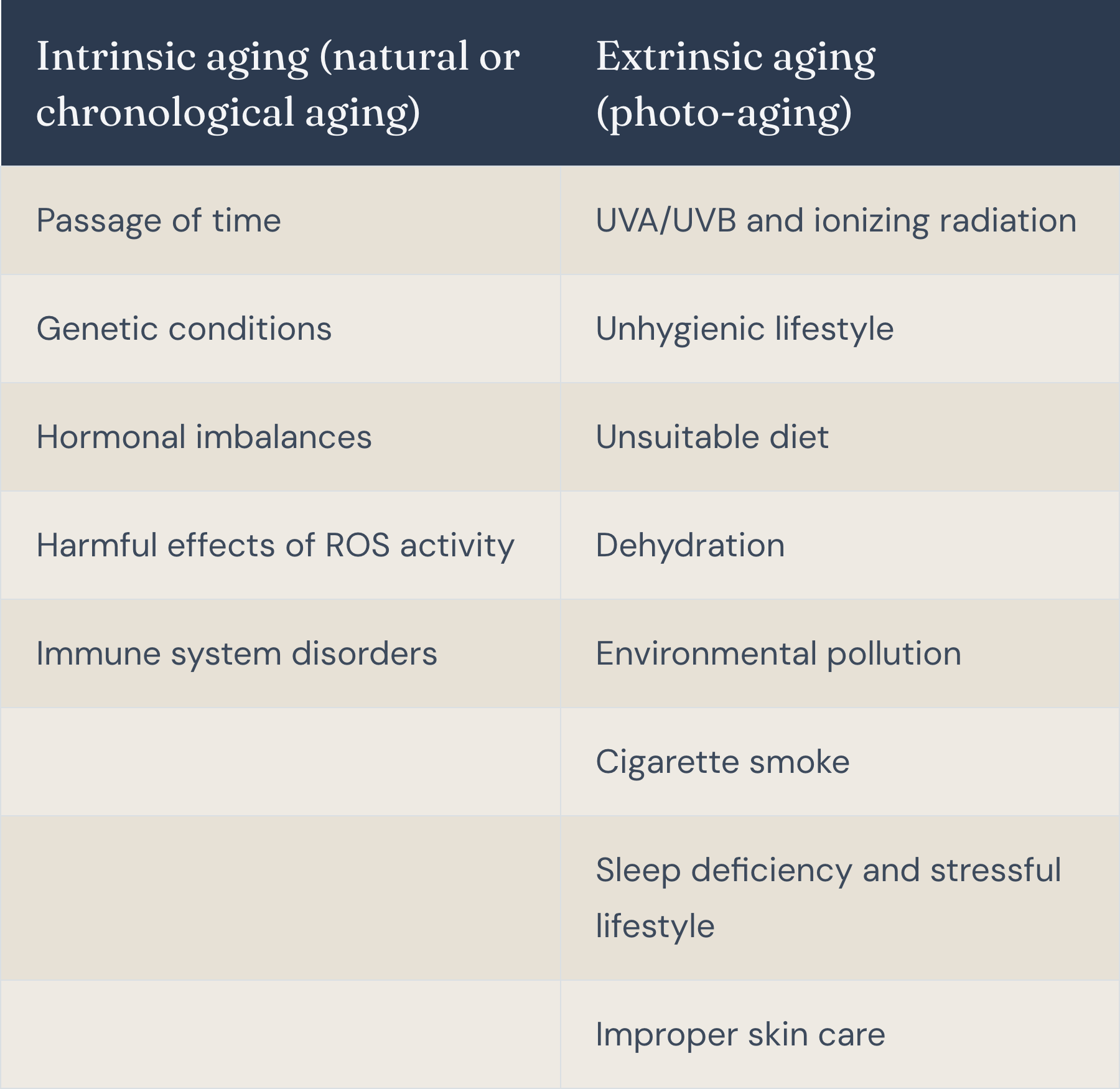
ROS, reactive oxygen species; UVA, long-wave ultraviolet radiation; UVB, medium-wave ultraviolet radiation.
Source: https://www.frontiersin.org/journals/medicine/articles/10.3389/fmed.2024.1484345/full
Q&A with the Coach
Everyone talks about collagen. Is it actually not that important?
Collagen absolutely matters — but it is largely a downstream effect of deeper processes, not the root cause. If you address the upstream mechanisms like senescence and inflammaging, collagen is one of several things that benefits.
What are AGEs and why have I not heard of them before?
Advanced glycation end-products form when sugars bind to proteins in your skin, stiffening and degrading tissue over time. They have been in research literature for years but rarely make it into mainstream beauty conversations — which is exactly why they are worth knowing about.
Should I be taking NAD+ supplements for my skin?
NAD+ precursors like NMN and NR are being studied for their role in mitochondrial function including in skin, but clinical evidence for skin-specific outcomes is still early-stage. Talk to your doctor before adding them — the pathway is plausible but the consumer product claims often run ahead of the evidence.
What does perimenopause actually do to these biomarkers?
Estrogen decline appears to accelerate cellular senescence, mitochondrial dysfunction, and inflammatory signalling in skin simultaneously. Research on perimenopausal women specifically confirms the 40–55 window is a period of compounding change, not just one shift.
How do I know if my skincare routine is addressing any of this?
Most standard routines are not — they are built around collagen marketing, which is valid but partial. The first step is knowing what the deeper markers are so you can ask better questions of your dermatologist and read product claims with more discernment.
The collagen conversation is not wrong — it is just incomplete. Research points to three additional drivers of how skin ages after 40: advanced glycation end-products, senescent cells releasing inflammatory signals, and mitochondrial decline as NAD+ falls. Perimenopause accelerates all of them together.
This is not a crisis — it is context. The women who navigate this period most effectively are usually the ones who asked better questions first.
What do you think?
If this shifted how you think about skin, there is more where that came from. Sign up for the new30 newsletter and get the science, without the noise, delivered straight to your inbox.
Created with AI assistance