

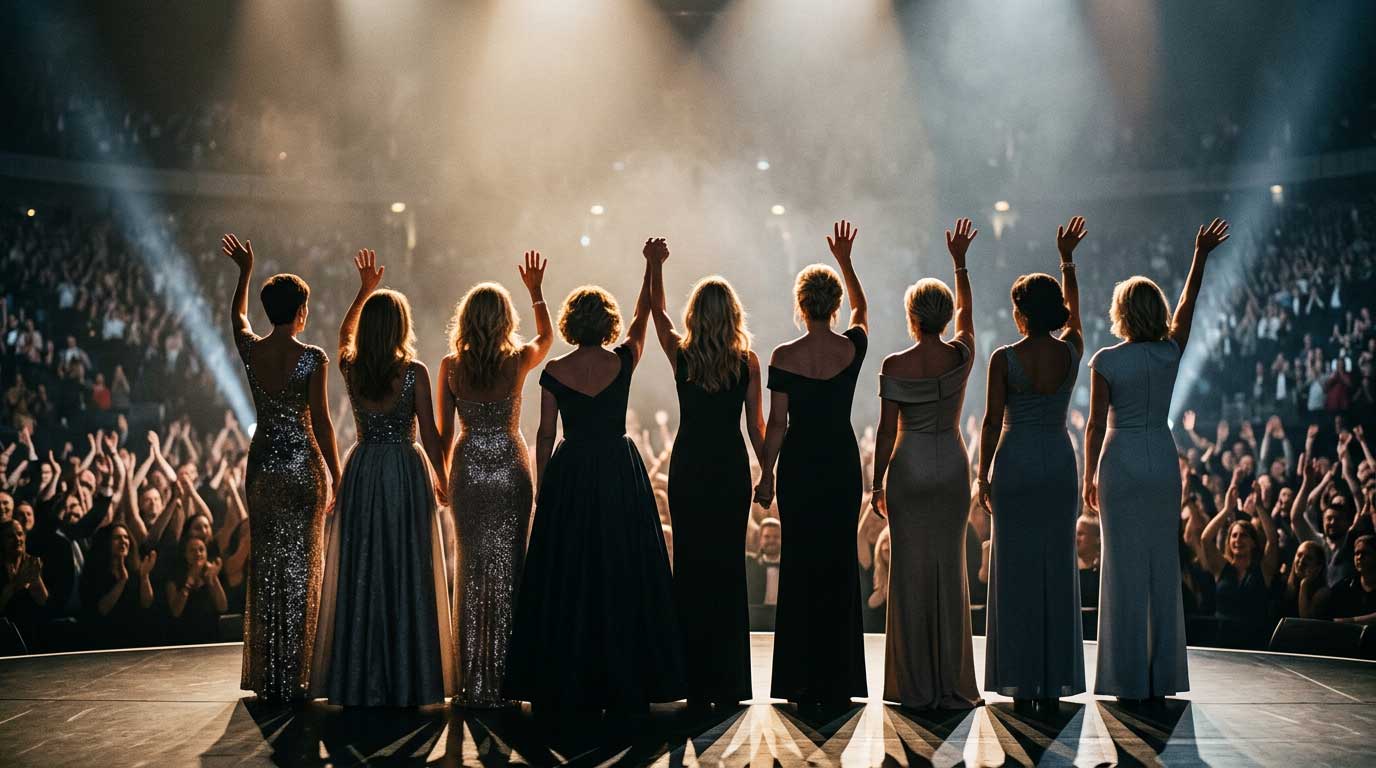
This summer, Forbes named 200 women over 50 who are doing the most significant work of their lives. Tracee Ellis Ross. Jennifer Garner. And 198 others proving this is not a consolation list.
Turns out, the research has something to say about this too. Your judgment, your expertise, and your capacity for impact keep developing well into midlife.
The short answer is that your brain is building, not declining. Crystallized intelligence — the kind that draws on knowledge, pattern recognition, and judgment — keeps rising through midlife, and a a 2025 study in Intelligence found that overall cognitive and personality functioning peaks between 55 and 60, right where career achievement tends to peak.
What's Actually Happening
Forbes' sixth annual 50 Over 50 list spotlights 200 women — including Tracee Ellis Ross and Jennifer Garner — across categories spanning innovation, impact, investment, and lifestyle. You can see the full U.S. list at Forbes. What makes this list more than a feel-good moment is what the research says about why it keeps happening.
A 2025 study by Gignac and Zajenkowski in the journal Intelligence pooled data from ten earlier studies and combined cognitive abilities with personality traits like emotional stability, conscientiousness, and moral reasoning. Their composite measure of overall functioning peaked between ages 55 and 60, which lines up with the age when career achievement typically peaks. Raw processing speed does slow, but other strengths keep building. This is a population-level pattern, not a prediction for any one woman, and the study wasn't specific to women. (Here's the study)
The biology says you're building toward something. The cultural narrative says you're past it. One of those is backed by peer-reviewed data.
Why This Matters for You
Here's the honest version: the biological and cognitive conditions for significant work are genuinely in your favor after 50. But the structural conditions are not always there to match. In a 2024 survey of more than 1,250 working women across 46 countries, nearly 8 in 10 reported experiencing age-related discrimination in their careers (Women of Influence+). And in the US, women aged 55 to 64 earn about 79 cents for every dollar men earn, the widest gap of any age group in Pew's analysis (Pew Research).
Purpose and connection matter for your body, not just your mood. A Nurses' Health Study analysis of more than 72,000 women found that those with strong social ties lived longer and had higher odds of reaching 85. The advantage shrank but persisted after accounting for lifestyle (study). Separately, research in the Journal of Psychosomatic Research found that a stronger sense of purpose in midlife is associated with better physical health later on. The effect is small but consistent (study).
What You Can Actually Do
- Audit your narrative — Notice whether the story you tell about your career trajectory is shaped more by cultural noise about decline than by your actual capacity, which the research suggests is still building.
- Take structural barriers seriously — Ageism in the workplace is documented and real; naming it clearly is more useful than assuming the obstacle is internal.
- Cultivate purpose and connection with intention — Whether through work, community, or creative projects, a sustained sense of purpose and strong social ties are both linked to better health outcomes in large studies of midlife and older women.
Q&A with the Coach
Is the Forbes list just a feel-good PR moment or is there something real here?
There's something real here. The list shows what's possible, and a 2025 study in Intelligence found that overall cognitive and personality functioning peaks between 55 and 60, around the same age when career achievement tends to peak.
I'm 52 and feel like I'm just hitting my stride. Is that actually possible or am I rationalizing?
You're not rationalizing. Crystallized intelligence, which draws on accumulated expertise and pattern recognition, keeps rising through your 50s even as raw processing speed declines. Research suggests judgment and depth of thinking are at or near their peak, though individual experience varies.
What about the very real barriers women face at work after 50? The list feels aspirational but my day-to-day reality is different.
That tension is real and documented. In one 2024 survey, nearly 8 in 10 women reported age-related discrimination at work, and in the US the pay gap is widest for women aged 55 to 64. The list matters partly because showing what's possible is one lever for shifting what's structural.
How does having a sense of purpose actually connect to health? That sounds a little soft.
It's not soft. A large Nurses' Health Study analysis found that strong social connection was linked to living longer and reaching 85, and research in the Journal of Psychosomatic Research found that a stronger sense of purpose in midlife is associated with better physical health later on. Both effects are modest, but consistent.
What's the single most useful reframe for a woman heading into her 50s who's been told her best years are behind her?
Research suggests that late midlife may offer the most balanced mix of strengths, with composite functioning peaking between 55 and 60. The more accurate reframe is that you're entering a high-leverage decade, not leaving one. Averages aren't destiny, but they're a lot kinder than the cultural narrative.
Two hundred women on a Forbes list. A 2025 study placing overall functioning at its peak between 55 and 60. A large longitudinal study linking social connection to longevity. Research connecting purpose to better health.
This is the moment to take the science as seriously as the celebration. The second half isn't a sequel — for a lot of women, it's the main event.
What do you think?
If this kind of research-grounded perspective on midlife power is what you're here for, our newsletter delivers more of it regularly — sign up and we'll land it straight in your inbox.
References:
Forbes — 2026 '50 Over 50' U.S. List (Forbes.com)
Forbes — 2026 Global '50 Over 50' List (Forbes.com)
Women of Influence+ (2024), ageism survey
Gignac & Zajenkowski (2025) — 'Humans peak in midlife: A combined cognitive and personality trait perspective', Intelligence (ScienceDirect)
Pew Research (2023), gender pay gap
Nurses' Health Study, social integration and longevity
Willroth & Mroczek, purpose in midlife