


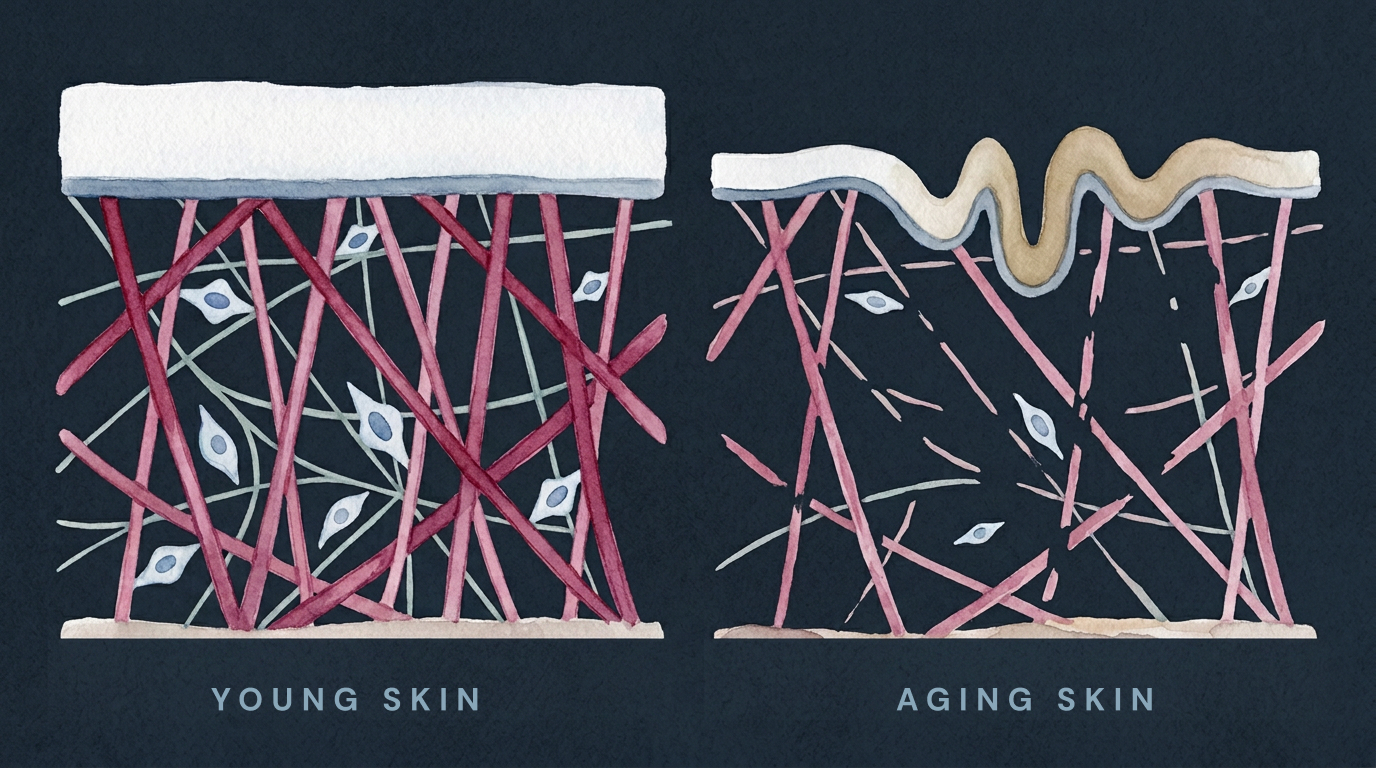
If you've noticed your skin feels thinner, drier, or less resilient than it did a few years ago, estrogen decline is likely a factor. A narrative review in Life (MDPI) covering six years of research concludes that HRT improves collagen content, skin elasticity, and hydration in menopausal women — and says the area warrants further investigation.
A 2023 meta-analysis of 15 controlled studies found that menopausal hormone therapy significantly improves skin collagen, thickness, and elasticity in women aged 45 to 55. HRT is not currently prescribed solely for skin concerns, so a conversation with your doctor is the right starting point.
What's Actually Happening
Collagen is the scaffolding your skin is built on — and estrogen is one of the signals that tells your body to keep making it. When estrogen drops at menopause, collagen production slows, dermal thickness decreases, and skin loses the hydration and elasticity that kept it resilient. This decline is measurable: older studies report that women lose roughly 30% of their skin collagen in the first five years after menopause.
A six-year narrative review published in Life (MDPI) concludes that HRT increases collagen content, skin elasticity, thickness, and hydration — and that its potential as a skin rejuvenation tool deserves serious scientific attention. A 2023 meta-analysis in the Journal of Menopausal Medicine pooled 15 clinical trials (1,589 women) and found statistically significant improvements in skin elasticity, thickness, and collagen content. The elasticity effect was small, and hydration was not one of the pooled outcomes.
Skincare and estrogen work through different mechanisms. Menopausal skin changes have more than one driver.
Why This Matters for You
If you're in your 40s or early 50s and feel like your skin shifted in a way your existing routine can't seem to fix, this research offers a structural explanation. Estrogen decline affects collagen, thickness, and hydration, which is one reason skin can feel different even when your routine hasn’t changed.
A recent narrative review is careful to note that findings vary across studies and that HRT isn't currently prescribed for skin concerns alone. But for women already considering hormone therapy for other reasons, the skin data is increasingly hard to ignore.
What You Can Actually Do
- Bring skin into your hormone conversation — If you're already discussing HRT with your doctor, ask directly about its documented effects on collagen and skin hydration. It's a legitimate part of the benefit-risk picture, not a vanity footnote.
- Ask about delivery methods — A small placebo-controlled trial of oral HRT in Climacteric found skin improvements over seven months. Reviews suggest topical estrogen may also help, though that evidence is thinner. Your doctor can help identify which form, if any, makes sense given your individual health profile and risk factors, including the small but real increase in breast cancer risk linked to combined therapy (Lancet 2019 analysis, summarized here).
- Give it time and measure it — Clinical studies showing skin improvements from HRT measured results over months, not weeks. If you start therapy, note your skin's baseline and check in periodically rather than expecting an overnight result.
Q&A with the Coach
How much collagen loss are we actually talking about after menopause?
Older studies suggest women lose roughly 30% of their skin collagen in the first five years after menopause. Some trials suggest menopausal hormone therapy can slow that decline, though results are not consistent across studies.
Does the research apply to women in early perimenopause, or only after full menopause?
Most of the controlled studies focused on postmenopausal women, so that's where the evidence is strongest. The mechanisms suggest perimenopause is a relevant window too, but your doctor is best placed to advise on timing.
I've been using retinoids for years. Would HRT do something different?
Retinoids stimulate collagen production in the dermis, with good trial evidence in sun-damaged skin (2022 systematic review). Estrogen acts through hormone receptors in the skin and affects collagen, thickness, and hydration. They work through different mechanisms, so they aren’t simply redundant. Your dermatologist can advise on combining them.
Are there women for whom HRT is clearly not a good fit for skin reasons or otherwise?
Yes — women with certain hormone-sensitive cancers, clotting disorders, or cardiovascular risk factors may not be good candidates, and that assessment is individual. The skin benefits are real, but they don't override a personal risk profile.
The research says findings can be inconsistent across studies. Should I be skeptical?
Healthy skepticism is reasonable. The trials are mostly small and use different hormones, doses, and delivery methods, and a recent narrative review notes that findings are sometimes inconsistent. A 2023 meta-analysis of 1,589 women found a modest but statistically significant signal for elasticity, thickness, and collagen. That is encouraging but not definitive.
The research is promising enough to take seriously: estrogen plays a role in skin collagen, elasticity, and hydration, and HRT showed measurable improvements in elasticity, thickness, and collagen in small to mid-sized trials. The effects are modest and the evidence is still developing, but it’s worth knowing about.
This isn't a prescription or a guarantee. It's an invitation to have a more informed conversation with your doctor — one where skin health is a legitimate data point, not an afterthought.
What do you think?
Want more research like this, translated without the jargon? Sign up for the new30 newsletter and get the science your doctor didn't have time to explain.
References:
Life (MDPI)
Journal of Menopausal Medicine – Skin Rejuvenation in Women using Menopausal Hormone Therapy: A Systematic Review and Meta-Analysis (PubMed, 2023):
Journal of Cosmetic Dermatology – Managing Menopausal Skin Changes: A Narrative Review (Wiley/PMC, 2025):
Climacteric – A Prospective, Randomised, Double-Blind, Placebo-Controlled Study on HRT and Skin Aging in Postmenopausal Women (PubMed, 2007):